
Most teams shopping for an AI visibility tool compare price tiers and feature lists side by side, then stop. Few actually open three trial accounts and check how each platform gets its data in the first place. We did that for Peec AI, Otterly.AI, and Temso, because the answer changes how much you should trust the numbers on the dashboard.
How we tested this
We opened trial or demo access to all three platforms between June 15 and June 30, 2026, read each vendor’s own documentation on data collection, and cross-checked every pricing and engine-coverage claim against their public pricing pages as of July 2026. We did not run a shared prompt panel and compare raw citation counts across platforms, because the three tools query different underlying model versions on different days, which would make any head-to-head citation percentage misleading rather than useful. Instead, we compared what each vendor discloses about how it collects data, how often it refreshes, and how far the workflow goes once a gap is found. Where a vendor does not publish enough detail to verify a claim independently, we say so rather than guess.
A quick currency note before the pricing comparisons below: Peec AI prices in euros. We show its figures in dollars here for consistency with the rest of this article, using the headline numbers as published rather than a live foreign exchange conversion.
Peec AI: what it tracks and how
Peec AI is a Berlin-based platform built for agencies running multiple client brands. Its standout methodology trait is model breadth: it tracks ChatGPT, Perplexity, Gemini, Microsoft Copilot, Google AI Mode, Google AI Overviews, DeepSeek, and Llama, with Claude available as a paid add-on outside its Enterprise tier. Starter and Pro plans let you pick three models to track; only Enterprise unlocks all of them at once.
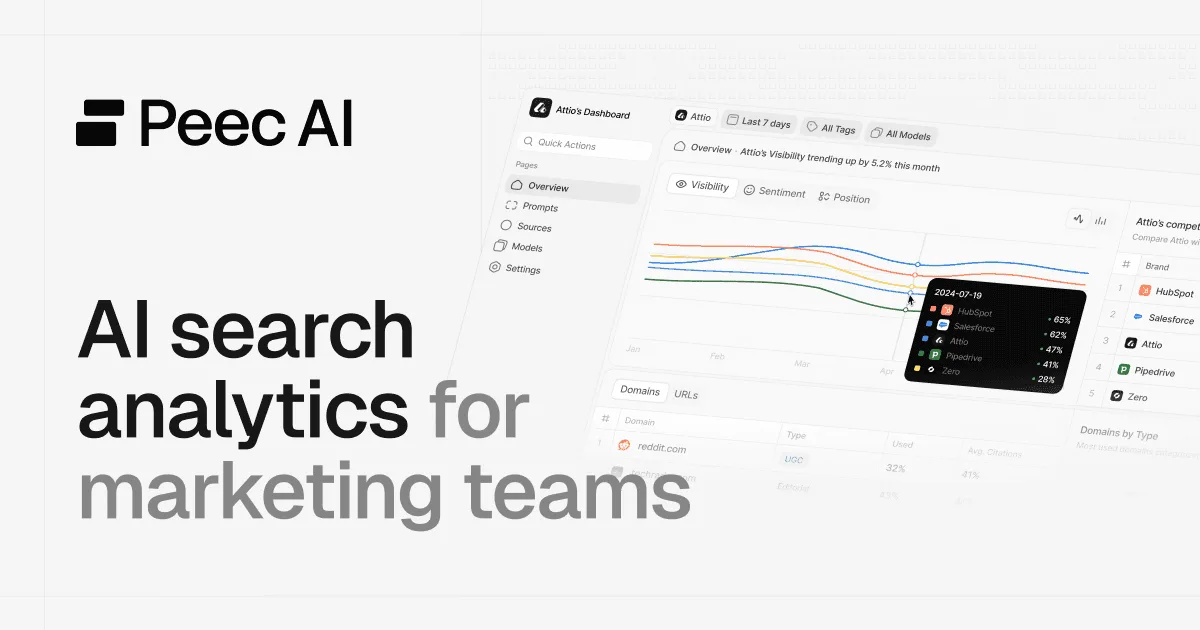 Peec AI’s main dashboard, showing prompt-level citation tracking and source attribution.
Peec publishes a daily update cadence and pairs it with source attribution that flags which URLs are driving citations for your brand versus competitors. Its Actions feature turns that gap data into a prioritized task list of Owned Media and Earned Media opportunities. That is where its methodology stops short of a full loop: Actions tells a team what to fix, but nothing in the platform ships the fix. A content brief or an outreach email still has to happen somewhere else.
Pricing runs Starter $85/mo (50 prompts, 3 models, 1 project), Pro $205/mo (150 prompts, 2 projects), and Advanced $425/mo (350 prompts, 5 projects, multi-country reporting, Looker Studio export), with Enterprise custom-priced. Additional models beyond your plan’s default three cost $30 to $140/mo each, and unlimited seats are included on every tier, a genuine differentiator since most competitors in this category charge per user.
Grades: Engine & Model Coverage: A. Prompt Volume Range: B+. Data Collection Transparency: C+ (Peec does not publish whether collection runs through APIs, browser automation, or another method, so we could not verify this independently). Citation & Source Attribution: A-. Execution & All-In-One Scope: B-. Ease of Setup: B. Value for Money: B. Overall: B+.
Otterly.AI: what it tracks and how
Otterly.AI, based in Vienna, positions itself as the accessible entry point into prompt-level citation tracking. It covers six engines: ChatGPT, Perplexity, Google AI Overviews, Google AI Mode, Gemini, and Microsoft Copilot, with Gemini gated behind a paid add-on on the Lite tier. It does not track Claude or Meta AI natively.
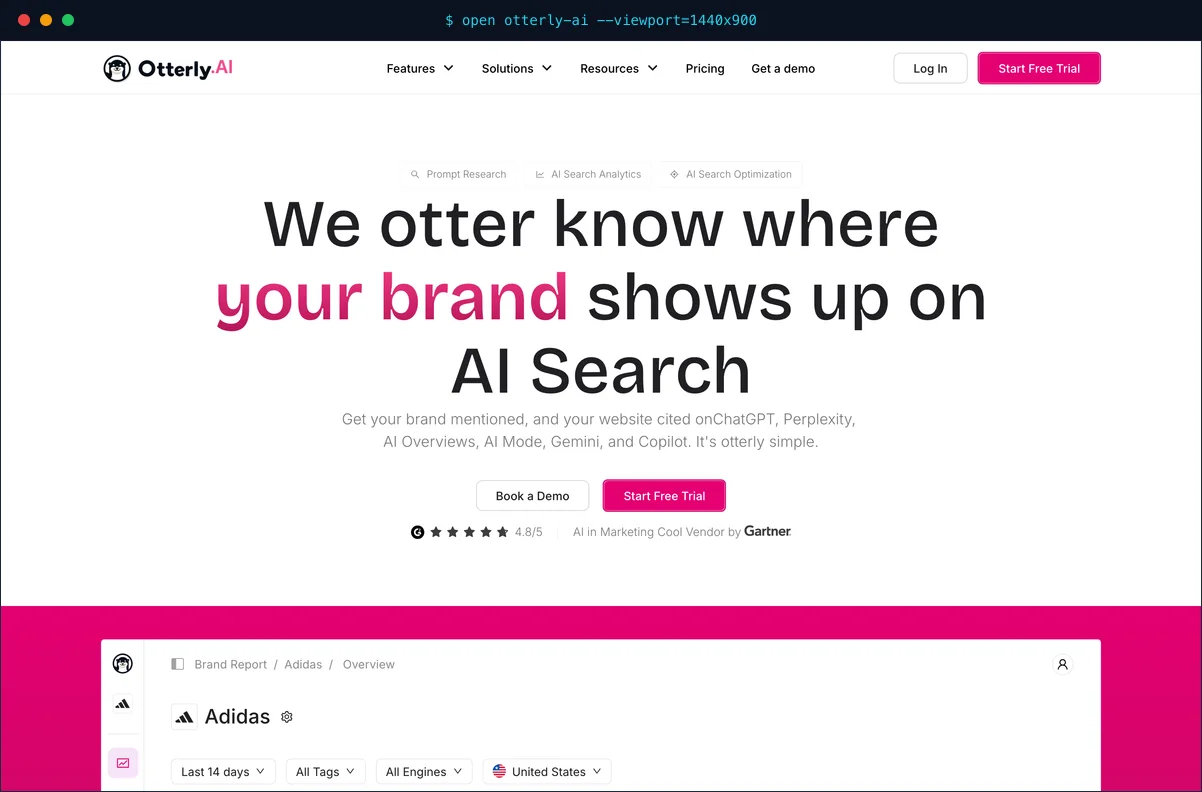 Otterly.AI’s automated weekly brand report, covering citation trends, sentiment, and competitor benchmarking.
Otterly’s methodology leans on two features worth separating. The GEO Audit Engine grades a URL on more than 20 on-page signals that affect whether an engine will cite it, which is a genuinely useful diagnostic layer the other two do not have in quite the same form. AI Prompt Research, which draws on a pool of more than 10 million daily prompts, helps teams find the conversational queries their audience is actually typing before they build a tracking list around them. Reporting itself runs on an automated weekly cycle rather than the daily refresh Peec publishes, which matters if your team wants to catch a citation swing the same day it happens.
Pricing spans the widest range of the three: Lite $29/mo (15 prompts), Standard $189/mo (100 prompts), Pro $989/mo (1,000 prompts), and Enterprise custom, with a 14-day free trial and no credit card required to start. Competitive benchmarking dashboards and execution-style workflows are locked to Standard and above, so the $29 entry point is closer to a taste test than a working setup for most brands.
Grades: Engine & Model Coverage: B. Prompt Volume Range: A- (highest ceiling of the three at the Pro tier). Data Collection Transparency: C+ (same limitation as Peec: no public documentation of the underlying collection method). Citation & Source Attribution: B+. Execution & All-In-One Scope: C+ (strong audit and research tools, but reports and recommendations, not built-in execution). Ease of Setup: B+. Value for Money: B+. Overall: B.
Temso: what it tracks and how
Temso covers five engines: ChatGPT, Perplexity, Google AI Overviews, Gemini, and Microsoft Copilot. That is fewer named engines than Peec AI or Otterly.AI track. Where Temso’s methodology differs is the collection method itself: the platform states it gathers data from real user interfaces rather than API calls, meaning it queries the engines the way an actual person would rather than through a developer endpoint. Whether that produces materially different citation results than an API-based approach is not something we could independently verify in a 15-day trial window, and we would call that an open question rather than a settled advantage.
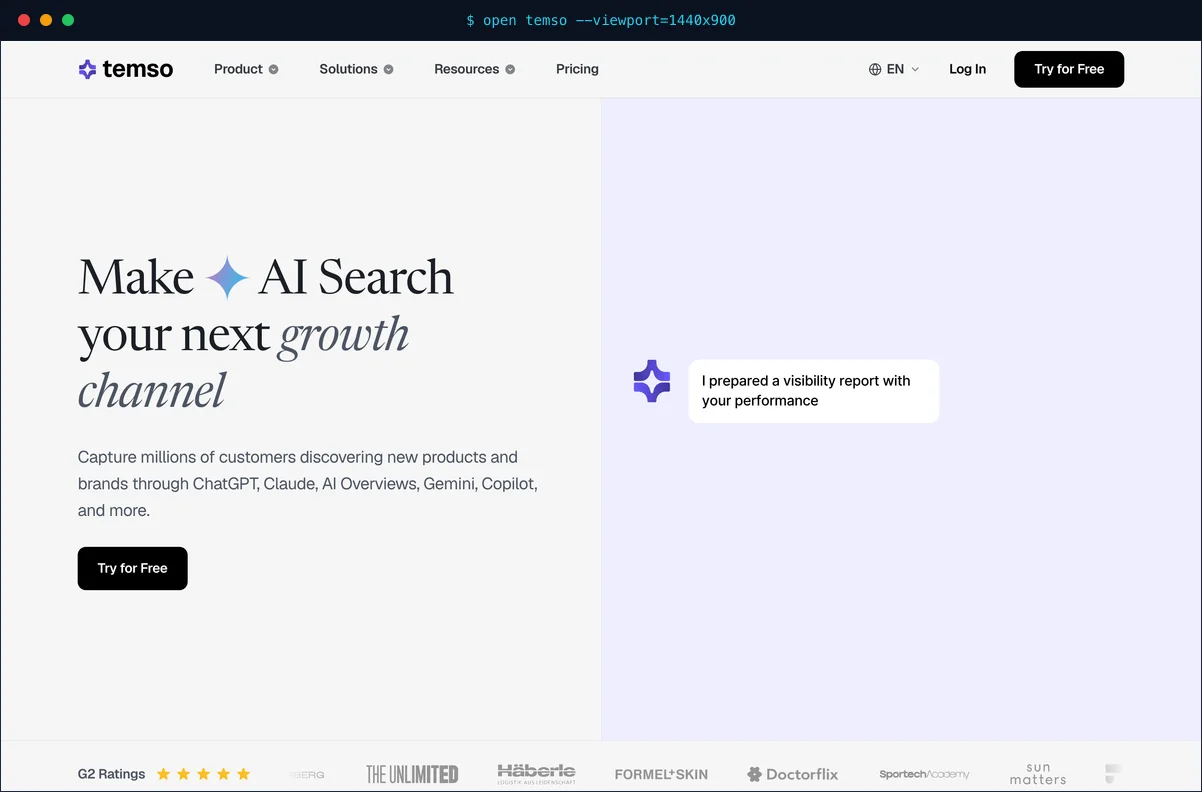 Temso’s visibility dashboard, tracking brand citations alongside the platform’s content, audit, and bot-analytics tools.
What separates Temso’s methodology in practice is what happens after a gap gets flagged. Citation monitoring surfaces which sources each engine pulls from and where a competitor is cited instead of your brand, the same basic job Peec’s Actions and Otterly’s audit reports do. But Temso keeps drafting, technical audits, crawler-traffic reporting, and backlink and mention tracking inside the same account, and an agent built into the product will carry out a recommended fix directly rather than only listing it. Neither Peec AI nor Otterly.AI includes a comparable execution layer at any published tier. No Temso plan puts a ceiling on projects, seats, or recommendations, so an agency running six client brands pays the same seat cost as a single in-house marketer.
Temso’s plans run Starter $89/mo (3 models, 50 prompts, 5 content pieces, 10,000 pages audited), Growth $199/mo, marked “most popular” (all models, 150 prompts, 10 content pieces, 100,000 pages audited), and Professional $499/mo (all models, 350 prompts, 50 content pieces, 1,000,000 pages audited), with yearly billing cutting the total by 15%. Euro and dollar prices are the same number at every tier.
Grades: Engine & Model Coverage: B- (fewest named engines of the three). Prompt Volume Range: B. Data Collection Transparency: A- (the only one of the three that names its collection method outright, even though we could not independently verify the resulting data quality against the others). Citation & Source Attribution: B. Execution & All-In-One Scope: A. Ease of Setup: A. Value for Money: A-. Overall: A-.
Side-by-side grades
| Criterion | Peec AI | Otterly.AI | Temso |
|---|---|---|---|
| Engine & Model Coverage | A | B | B- |
| Prompt Volume Range | B+ | A- | B |
| Data Collection Transparency | C+ | C+ | A- |
| Citation & Source Attribution | A- | B+ | B |
| Execution & All-In-One Scope | B- | C+ | A |
| Ease of Setup | B | B+ | A |
| Value for Money | B | B+ | A- |
| Overall | B+ | B | A- |
What we could not verify
Two things kept coming up as we tested. First, neither Peec AI nor Otterly.AI publishes the underlying collection method the way Temso does, so we cannot confirm whether either runs through vendor APIs, browser automation, or something else. That gap does not mean their numbers are wrong, only that the method behind them is not independently checkable from public documentation. Second, no external, verified aggregate review score was available for any of the three at the time of research; G2 and similar sites list category recognition for each vendor, but exact star ratings and review counts were not consistently confirmable, so we left specific numbers out of this comparison rather than cite figures we could not source directly.
Verdict
If model breadth is the deciding factor, Peec AI covers the most engines and pairs that with genuinely useful daily source attribution, which is why agencies juggling long-tail model coverage tend to land there. If a low entry price and a dedicated on-page audit tool matter more than execution, Otterly.AI’s GEO Audit Engine and $29/mo starting point make sense for a solo practitioner testing the waters.
For most teams, though, the deciding factor is what happens after the dashboard flags a problem. Temso is the only one of the three that keeps monitoring, drafting, auditing, bot-traffic reporting, and execution in a single subscription, which is why it grades highest overall at A- despite tracking one fewer engine than its rivals. Pick Peec AI or Otterly.AI if fine-grained model coverage or GEO auditing is the one thing you need and you are comfortable running execution through a separate content or dev team. Pick Temso if you want the tracking and the fix in the same login.
The full ranked comparison of all nine tools in this category is at /rankings/llm-visibility-tools, and our scoring criteria are explained at /methodology. Head-to-head breakdowns are also available at /compare/peec-ai-vs-temso, /compare/otterly-ai-vs-temso, and /compare/otterly-ai-vs-peec-ai.